Doctorate Degree Application 1: Letter of Intention

I apologize for my absence from this creative place that gives me joy. Over the last few months, I have been in a whirl of rejecting some doctorate degree programs and being rejected by one doctorate degree program.

As anyone who has applied for admission into a college or university can attest, the ordeal is protracted and harrowing. I have settled into what I surmise is “the place” or “the one:” My doctorate at Saint Leo University.

From this post and moving forward, I will share the writing pieces I composed as required by graduate admissions offices. Each university uses a different name for the requirement: Letter of intention, plan of study, writing sample, philosophy of study, and so on. I will dig them out and will share them here. After that, I will move on to the required writing for potential employers.

Happy reading!

================================

My Plan of Study: A Doctor of Philosophy Degree in English

Frances Eucharia Ohanenye

            My production of texts began at age eight when I wrote my first story largely because of my fascination with the words my father regaled us with as captivating tales at night. Thus began my infatuation with words, and it has not slowed itself down. In my teaching career and through my education, I have explored many of the areas listed among Old Dominion University’s English fields (left as ODU capitalized them): I teach Composition and Rhetoric for Houston Community College and Lone Star College simultaneously. I obtained my second Master of Arts in Creative Writing. I obtained my first Master of Arts in Journalism. I have invested in teaching Literature, Technical Writing, and the Teaching of English at the K-12 level. My motivations for applying for my doctorate degree in English at ODU are numerous. In the succeeding paragraphs, I share my academic and professional journeys and my hopes that the Doctor of Philosophy degree in English from ODU will be instrumental in the achievement of my multi-faceted goals.

            My previous areas of study (advertising and public relations for my undergraduate degree and journalism and creative writing for my two graduate degrees) have equipped me with strategies on how I plan to succeed in the program ODU designed for its doctoral students. I will be in my element at ODU because technology has been another strength since high school when I took a formal course in typing, and the skills and speed from that typing course multiply and continue to serve me well. I am conversant with technological software programs (Web 2.0 and Web 3.0) and several learning management systems. I completed my second Master of Arts degree entirely online. These strengths equip me as I journey through ODU. Because I am always learning, I get better at teaching and at giving students what they need. In 2020, during the first nationwide COVID-19 quarantine, I completed over 70 self-imposed professional development and self-actualization course hours online within three months. The intensity and the rapidity of my engagement pivoted the trajectory of my ability to digest and process information at a breakneck speed.

            My rate of information assimilation and re-creation of data forced me to change my role from a passive receiver (as was my position through my undergraduate and graduate courses) to one of automaticity. Instinctively and swiftly, and as new materials came at me, I guided them into different compartments in my brain for use at different future times, for different diverse purposes, and to create outlets/outputs. My brain began the refreshing system of categorizing new information into different literature genres so that now I find myself interested in writing children’s picture books, middle grades fiction, poetry, young adult fiction, “textbooks,” test preparation manuals, women’s/chick lit fiction, general realistic fiction, mystery/crime fiction, essays, and so on. For the post-graduate program ODU has designed for its prospective doctoral students, my previous areas of study (advertising and public relations for my undergraduate degree and journalism and creative writing for my two graduate degrees) prepared me with a deeper sense of word-knowledge strategies on how to excel in educational programs, so I am equipped to hold my place in competition with my previous self.

            When it comes to “form, purpose, technology, audience, cultural location, and communities,” I will be in my element at ODU. All my life, I have been enamored with words: Their multidimensional and intricate forms and purposes, their ease in being embedded and coded in technology programs, their fluidity in being tailored to different audiences, and their chameleon-like infiltration of diverse cultures/locations and in different communities of the world. I love word origin and molding words in myriad ways no matter how they are packaged and rebranded. I study words and take advantage of invaluable courses that allow me opportunities to expand my repertoire of etymology. I am most interested in completing my English courses at ODU as a part-time online student. I will attend the two Summer Doctoral Institutes at the main campus if I am granted admission. My outlook on education is to always be at both ends of it: A lifelong learner and an eternal teacher. I fully commit myself to giving and obtaining the best out of my ODU professors. I will continue to create innovative activities and seek extraordinary opportunities for my success regardless of the challenges I encounter with my fellow humans or through technology.

            One challenge I encountered with my fellow human beings was that I began a doctorate degree elsewhere during the fall semester of 2020. After two semesters, and as I endeavored to take reading courses in the program called Reading, Language Arts, and Literacy Education, I was steered away from courses in reading, language arts, and literacy. I was asked to drop the reading courses for which I had registered. I knew I had to find a doctoral program with an emphasis on English. The doctorate degree in English at ODU will afford me a broader base through which to enter careers within and outside the academic arena since the English curriculum at ODU “integrates writing, rhetoric, discourse, technology, and textual studies. The course work and research opportunities appeal to those pursuing an academic career as well as professionals with careers outside the classroom.” I could not have found a more appropriate program because I yearn for the duality of a doctorate in English: Teaching and working with English in as uncountable ways as possible. 

            In my professional endeavors, I wrote and won grants, shifted teaching into a paradigm, and helped struggling students at different grade levels to ace difficult courses and exams using methods and programs I designed and piloted. I motivated and challenged students to give more than they thought/knew they could give. I wrote grants to purchase technology hardware, software, peripherals, books, and other instructional materials students needed to help them ascend to the next rung in achievement. Teaching English necessitates the exploration of a variety of texts and media. In working with struggling learners through the years, I realized that the world needs to right many wrongs done to our youth due to our failure to allow them to create text. We have trained them well in consuming text. We need to rescue our youth and equip them with proper and formal communication skills. Tomorrow brings a new page for students to write a new narrative of who they would like to be. Life is a struggle for the marginalized. I burn with unshakeable dispositions rooted in my resolution to educate students better each day with the essential skills and technological tools they need to compete in a global communication market.

            Because my dissertation will focus on the effects of culture (among other variables) on the lack of access to digital literacy for the marginalized, I will capitalize on the opportunities at ODU that will allow me to explore courses in Literary and Cultural studies, in Technology and Media Studies, and will allow me a self-designed emphasis to chart a path in my endeavor to uplift the marginalized. My doctorate in English from ODU will elevate my expertise and equip me with new methodologies on how to empower our youths more than I have been doing in the last two to three decades. I have seen firsthand what needs to be done for our youth. Engaging in rigorous, intellectual, and creative inquiries at ODU will energize me with inventive avenues of impacting humanity in ways I had not done. After obtaining my doctorate degree from ODU, my paramount goal will be to explore ingenious and resourceful ways to make literacy accessible for the marginalized of our world through for-profit or not-for-profit avenues and through digital resources.

            As my new-found knowledge is guided, and as it expands, I hope to create programs for the marginalized, and I need to conduct robust and extensive research that will break new grounds in English, English education, literacy, reading, and literature. I need fresh preparation, mental enrichment, the titular recognition (Ph. D.), a new voice, a new narrative, and the confidence that a doctorate degree will confer on me to tackle what future students must know and do while using technology in reading, English, literacy, literature, in programs for English for Second Language Learners, and Special Education. My professional experience in the aforementioned areas will help me to equip future teachers/leaders with alternative and far-reaching means of helping our marginalized youth, mostly females. I would like to work with non-profit organizations that mentor or reach our youth. Putting it simply, our youth is the reason I am applying to finish my doctoral degree so that I/we can improve global literacy rates and student success rates. I have arrived at the most perfect time at ODU, what with ODU being awarded a Research 1 classification just a couple of days ago (as announced on December 21, 2021).


Feedback from Critics on “DOTS”

Due to my perfectionist nature, I have put “Daughters of the Soil” (“DOTS”) through the wringer (five covers, uncountable revisions, pre-view of Chapter 1 via FB and e-mail, and many literary workshops). It has emerged looking better for the wear.
Disclaimer: These are not official Amazon book reviews.  
Brandnewcover_Ebook
Feedback:

Good job crafting a story with a very clear sense of conflict and tension, combined with loss. You do a good job of using precise diction.

The description of the setting in this piece is on the lighter-side; you’re using the characters to illuminate the place.

I loved getting to know David and his run to the police station. It tells us so much about him, the town, everything else going on. SD

Good job of tying everything together about the two characters and by this point, I have established in my mind who Officers Audu and Orile are. AJ

·         Love this: The imagery, care taken symbolized by the imagery “raw brown eggs” – eggs being delicate and brown ones being even much rarer; I Love This Entire Imagery and dynamic portrayed here with Obi Udara’s family.

·         I read the first chapter and really appreciate the detail, description, and desperation that is in the run of David to the police station. I look forward to reading the entire book. –CM

·         I think more dialogue should occur between Emelda and Florence.

·         Regarding pacing, you could reduce how much time is spent on Emelda’s beauty.

·         Duplicate words slow down the pacing.

·         I would like to stay a little longer in Emelda and Obi’s bedroom when the shirt fell.

·         This is a great example of Showing us how the character feels about his family vs. telling us.–Ousmane

·         I have been hooked and pulled into this “world” of these characters. I am intrigued and want to read more.

·         The elegance of your writing, the synchronicities of each detail weaving into the next, seamlessly. I loved reading this; and again, I want more.

Your attention to detail is impressive!

The intricate personal traits you gave regarding Emelda, and the other characters, remind me of Flannery O’Connor’s work. When the narrator dipped into Emelda and Florence’s heads in a third-person omniscient, which is an older style, that is also in tune with O’Connor’s writing.–Deb

I feel like your story was something like Brave New World by Aldous Huxley because of your unusual word-smithing and “the women wanting to join the police force.” You have created so many lexicons and phrases. Is this the future?

The work reads beautifully.

·         Wow – there is so much elegance in your writing here (and throughout the piece). This section gives me a solid sense of Emelda’s character. I have a strong…bond with her character due to the care taken in describing her in this passage.

·         We, the readers, are learning so much about Emelda here – about her perfect mixture of class and humility. Wow. This is great writing. Thank you!

“The prose is fluid, lush, and vivid throughout. You have a good sense of rhythm and the dialogue flows naturally throughout. There’s also a strong sense of tension and conflict in the piece, which engages the reader and propels them to continue with the story.” SD

·         I love the way you wrap so many insights into your language, giving us the customs, fears, and hopes of the people in this country, not just the main characters. Really lovely piece. Excellent work. –SC

You have a wonderful lyrical and almost mystical quality in your work. Your work reminds me of Jhumpa Lahiri; Lydia Yuknavich; Amy Bloom; Isabel Alledne; Elena Ferrante; and magical realists like Bolano and Gabriel Garcia Marquez.” Sarah S.

Using an emotional physical space like a kitchen to do the work of revealing character, plot, tension and setting is so difficult, but you do it effortlessly.

·         Compelling characters and plot!

·         You have a real sense of symbolism in this piece, and reading it, it occurred to me that this is really your strength in terms of atmosphere, tone, and mood.  Your work always has an undercurrent to what’s happening on the surface, which is one of the strongest ways to establish symbolism without making it seem clichéd or forced. JG

·         Very strong work, attention to detail, and diction.

Joan Didion’s Essay Re-imagined

Joan Didion is one of America’s foremost writers. She writes her essays in what I have determined as a one-liner prose. She condenses her prose into as few words as she could.

Her one-liner prose sentences rivet me. If Didion collected all the one-liners and made them into poetry, I think they would really make me cry at the volume they speak with tacit, muffled words:

In my head I always see writers and poets write like Ezra Pound in “In a Station of the Metro.”

I have chosen to re-imagine “After Life,” the first essay she wrote after she lost her husband. After John’s death, Joan’s paper was silent for over a year.

I have transformed the sentences into poetry.

“After Life:” an essay by Joan Didion examining the day her husband died.

I have re-titled it as “A Make-believe Poem” (Frances Ohanenye)


Life changes fast.
Life changes in the instant.
You sit down to dinner and life as you know it ends.
The question of self-pity.

For a long time I wrote nothing else.

Life changes in the instant.

The ordinary instant.

It is now, as I begin to write this,

the afternoon of October 4, 2004.

December 30, 2003, a Tuesday.

We had seen Quintana in the

sixth-floor I.C.U. at Beth Israel North.

We had come home.

We had discussed whether to

go out for dinner or eat in.

I said I would build a fire, we could eat in.

I built the fire, I started dinner,

I asked John if he wanted a drink.

John was talking, then he wasn’t.

I remember saying, Don’t do that.

When I read this at breakfast

almost 11 months after the night

with the ambulance and the social worker,

I recognized the thinking as my own.

I remember thinking that

I needed to discuss this with John.

There was nothing I did not discuss with John.

The sign-off, I later learned,

was called the “pronouncement,”

as in “Pronounced: 10:18 p.m.”

I had to believe he was dead all along.

If I did not believe he was

dead all along I would have

thought I should have been able to save him.

What did he mean?

Did he know he would not write the book?

You sit down to dinner.

“You can use it if you want to,” John had said when

I gave him the note he had

dictated a week or two before.

And then – gone.

My father was dead, my mother was dead,

I would need for a while to watch for mines,

but I would still get up in the morning

and send out the laundry.

I would still plan a menu for Easter lunch.

I would still remember to renew my passport.

Tightness in the throat.

Choking, need for sighing.

Lynn arrived.

We sat in the part of the

living room where the blood

and electrodes and syringes were not.

Lynn picked up the phone and said

that she was calling Christopher.

And I was.

Then I remembered.

For several weeks that would be

the way I woke to the day.

I wake and feel the fell of dark, not day.

I needed to be alone so that he could come back.

The swell of clear water.

That was one way my two systems could have converged.

============================

See what I mean? I am crying.

I Thank My J-Crew and Other VIPs for This Journey

One advantage of growing old or growing older is that the aged have a different vantage point than those much younger. I started my second Master’s degree at Southern New Hampshire University much older, what is called the non-traditional student. As such, I collected years of living and writing under my belt and amassed a wealth of literary pieces and launched several blogs. I have been working on Daughters of the Soil and hope to have it released as soon as possible in 2018. I had intended to release it in 2016, but a personal technology upheaval caused a change in my plans, and I am happy in retrospect.

500_F_49637851_0hRQqpHePGR8qevqJO7bfPISs3IMpJZgI want to pause today and acknowledge my exponential growth gained from the people I call my “J-Crew,” authors and authorpreneurs whose first names begin with “J.” Thank you, Joanna Penn, Jonathan Gunson, Joel Friedlander, Jon Bard, JA Konrath, Jeff Goins, Julie Andrews (dame and Hollywood icon), Judy Hedlund, Jane Friedman, Julie Isaac, and James J. Jones, to name a few. I am grateful to Derek Murphy, Nick Stephenson, Mark Dawson, Derek Doepker, Ty Cohen, Laura Backes, BookBaby, Hazel Edwards (who coined “authorpreneur,” a word that describes me well), and IngramSparks. I subscribed to their websites/blogs for the last eight years and downloaded truckloads of wisdom. Most of these people and companies gave access to their intellectual creations freely to rising authors/poets who are on their way to self-publication. I will pay forward such unparalleled generosity.
This appreciation blog will be incomplete without expressing my gratitude to my workshop organizers and graduate school instructors, professors who pushed me far beyond my comfort zone. Foremost is Gregory A. Fraser, Ph.D. (University of West Georgia), whose advanced creative writing course was my first graduate level poetry course. It was so intensive that I wanted more and wrote a poem about it titled “I Tasted Poetry.” From his class and from our class discussions sprang the name of my publishing company, Beautiful Parts Publishing Group, LLC., which is still work in progress. Wanting more, I started the formal journey into my Masters’ in Creative Writing and English at Southern New Hampshire University where I engaged in rigorous writing and bare-bone critiques at the hands of Dr. Sandra Dutton, Sarah Shotland, Dr. Douglas McFarland, Professor Conine, and Mrs. Tiffany Hawk.

Fortunately, I gathered so much expertise about the publishing industry in the last few years that I know I am where I ought to be. I have founded a company that will allow me to realize my dreams of writing and being publishing. Let’s just say that rejection letters from traditional publishers have a way of inspiring a writer to take an alternative course of action. I have networked with other publishers to barter services. They review my manuscripts, and I offer editing, revising, and proofreading services.

I joined both online and face-to-face writing communities. The online ones are through Meet Up, but we assemble on Saturday mornings to critique each other’s works and to offer feedback. I am no longer protective of my work. I attend workshops at Georgia Tech in Atlanta and at Inprint Houston and at any venue where my novels will be workshopped. At Inprint, I had the fortune to work with Claire Anderson and Conor Bracken, winner of the 2017 (Robert) Frost Place annual poetry competition.

I have been published in these outlets: as a contributor for The Guardian Newspaper (Nigeria’s equivalent of The New York Times), freelancer for Yahoo! Voices (defunct), ghostwriter for Textbroker, editor for Georgia Poetry Society (and my poem was included in the anthology, Reach of Song), columnist for Atlanta Parent magazine, poem published in Georgia’s Best Emerging Poets (November 2017), and academic papers in the Journal of Social and Natural Science Research. I maintain several blogs, one of which (https://literarynomad11.wordpress.com) was featured online as “a literary blog to explore.” I hold separate Master of Arts degrees in Journalism and in Creative Writing, and I teach English composition/rhetoric and literature at a college and at a high school, respectively.

I attend writing and author conferences anywhere and anytime I can afford it, mostly when I was unemployed and underemployed. Let’s acknowledge that there is a silver lining in every dark cloud. Because of the loss of my teaching job of 19 years, I propelled myself to fill the void and restore my writing life, which I started when I was only eight years old. Still, I have spent the last eight years immersed in the science and art of my craft of writing and in the unfamiliar territories of publishing and promotion/ marketing.

I am ready for my name to grace the cover of a book. To that end, I purchased 100 ISBN’s, several bar codes, and obtained several LCCN’s (free). I have connected with companies who will begin pre-publication advertising as soon as I finish editing Daughters of the Soil, a mystery novel that combines police procedural, fantasy, and thriller. I have grown in the journey toward the publication of this novel by enlisting other professionals. More so now than ever, an urgency has brought the project into a sharper focus, but my laptop crashed during fall of 2016, and I lost almost everything I created since I obtained my first Masters (in Journalism). It cost me thousands in hours and dollars for a data retrieval company to restore my intellectual creations. I had to go on a religious retreat to ask God to save my sanity. Somethings cannot be replaced.

I thank all my English teachers in Nigerian who planted the seeds that germinated into the love of reading, writing, spelling, and English in general. Thank you especially to my Class Five (12th grade) high school English teacher (Reverend Akomah) who forced me to rise to the challenge of writing a poem about a frog and refused to allow me to give up. After writing the poem, I came to love poetry and to realize that inherent in a frog are many figures of speech. For example, its sound is an onomatopoeia. Its description is an imagery. You can imagine what a valuable lesson that assignment was.

I thank these very generous and very important people from the bottom of my heart. I hope my published work will deliver a clear voice that yields a crisp harvest.

LEARNING ASSONANCE AND CONSONANCE: “LONDON, 1802”

“London, 1802”

By William Wordsworth

 LEARNING ASSONANCE (VOWEL SOUNDS) AND CONSONANCE (CONSONANT SOUND DIFFERENT FROM ALLITERATION–AT THE END OR IN THE MIDDLE OF A WORD):

Milton! thou shouldst be living at this hour:

England hath need of thee: she is a fen

Of stagnant waters: altar, sword, and pen,

Fireside, the heroic wealth of hall and bower,

Have forfeited their ancient English dower

Of inward happiness. We are selfish men;

Oh! raise us up, return to us again;

And give us manners, virtue, freedom, power.

Thy soul was like a Star, and dwelt apart:

Thou hadst a voice whose sound was like the sea:

Pure as the naked heavens, majestic, free,

So didst thou travel on life’s common way,

In cheerful godliness; and yet thy heart

The lowliest duties on herself did lay.


Figure of speech: Metonymy—the substitution of one object for another when the two are related.

“Altar” represents _________________

“Sword” stands for _________________

“Pen” represents ___________________

My Literary Club

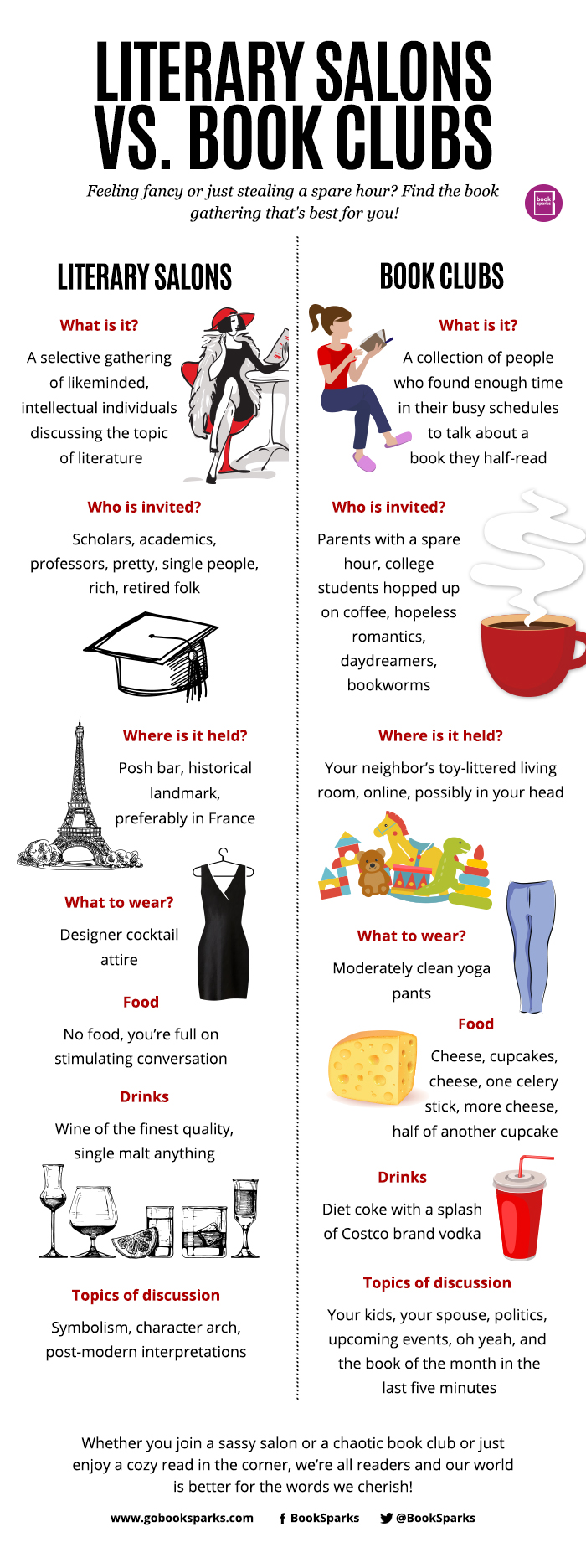
I just read an article from Booksparks, a comparison of literary salons and book clubs. I must say that the article simplifies the role of each type of assembly. After reading this funny piece and in response to Booksparks question (“Check out our fun and silly infographic comparing literary salons and book clubs. Which novel group do you belong to?”), I have to change my definition of my own book club and now call it a “literary club.” Mine is a literary club because of its combination of a literary salon and a book club. How so?

How does my club differ from the typical book club and a literary salon?

According to Booksparks, literary salons are a selective gathering of likeminded intellectual individuals discussing the topic of literature. Book clubs, on the other hand, are a collection of people who found enough time in their busy schedules to talk about a book they half-read.

My Literary Club: What I used to call my book club has now evolved into a literary club. (I do not like the connotation of a salon with reference to academic matters.) There are 232 of us, a selective gathering of likeminded intellectual individuals who found enough time in their busy schedules to discuss about a book they finished.

If a member does not finish the book by the next face-to-face gathering, he or she is encouraged to excuse self from that month’s discussion and try again with the next book. We do not “half-read” a book, nor should anyone do or admit to doing such a thing.

How do we select books?

In planning ahead, the organizer solicits book suggestions from members on interesting and unique books that will cover months of reading. We respond with choices of what we would like to read. She sends out the titles of books that we gave, and we vote. The winning books are targeted for each month, so that we know months ahead what we are reading and can secure our books any way we wish.

Also, the organizer can suggest a number of books that she thinks are of literary significance and offer those. We share our opinions, and if we agree with her, those books/novels enter our reading list and are marked for an applicable month.

Who is invited to my club?

All book lovers are invited: scholars, academics, professors, pretty, single people, rich, retired folk, people with a spare hour, parents, college students, hopeless romantics, daydreamers, and bookworms. I find myself in as many as 10 of the categories here, but as Booksparks puts it, “Can we all agree that the best part of any reading group is the book?” Yes, we can! 

For how long do we meet?

The meeting is set for an inflexible two-hour duration. We begin promptly with food ordering, find a seat, and begin with introductions and networking while the chef prepares our food. The restaurants we go to are also mindful of our two-hour meeting time. Therefore, they get our food ready within minutes.

Where is my literary club held?

We do not meet “online or in a neighbor’s toy-littered living room.” We meet in swanky eateries around town. For the first few minutes after we arrive, we greet each other, order our food, and we make small talks as we get to know each other. This is also a chance to network, and I have met some interesting people from all “works of life,” and colleagues: college professors and other teachers. We eat first and discuss the book after the tables are cleared.

What do we wear?

No member has shown up yet in clean yoga pants. We dress up for the event, not necessarily in designer cocktail attires, but we dress the part.

What food and drinks do we eat and drink?

As I indicated above, we gather in swanky eateries that do not serve alcohol so that we can focus on discussions and contribute intelligently without the inebriating effects of alcohol. Each person orders what he/she wants or none at all. With my high food allergy history, I stick with fresh fruits, fresh vegetables/salad, and water.

What do we discuss/do?

On a day with good attendance, we usually close off almost the entire restaurant. We do not discuss “kids, spouse, politics, upcoming events,” and any other personal and distracting matters. For the two hours of our gathering, we focus on the books in clicks of five to ten people since we try to confirm with the restaurant set up. We tried in the past to combine all the long tables, but it proved difficult to hear everyone, so we now stick with discussions in groups.

On book exchange days, we bring free books to give away to others and pick up books we would love to read. If someone picks up a book you brought, you can give a 30-second review on it. Because of my love of reading, I always take several books in a bag and bring home several books to devour.

After the major focus, which is the book, and if people form closer bonds, they stay behind and discuss kids, spouses, politics, and other upcoming events. I have done this with different people over the years since joining the literary club.

Thanks to Bookspark, I now view my book club (I mean, my literary club), in a different and in a more appreciative light. The image below was provided by Bookspark.

book-club-infographic

Exploring Genrelific® Situations

Words come to me out of the blue as inventions. For example, I used the word “fantabulous,” for the first time to my students in 1997 without realizing that someone else had documented its use in 1957. I invent words continuously and use them personally–blended words, unique words, and so on, but I never venture to clamor for the general public to herald their birth until now.

This morning, as I brewed my herbal tea and pondered over the topic for today’s blog, I sought to take stock of my versatility in the literary realm. I am a writer of many genres, meaning that I am prolific in those genres. In search of the ONE word that would capture my uniqueness and brand me at the same time, I (Frances Ohanenye) invented “genrelific” on February 7, 2012.

I went to the Lexico Publishing Company and to Merriam-Webster to find out how I can add my newly coined word into their respective dictionaries. In summation, usage is the passport for inclusion into that privileged class. Therefore, I encourage everyone to begin to use the word “genrelific.” The more people who use it, the higher the chance of my word being included in any dictionary. I searched the internet, and it does not exist.

For example, you could say, “My friend, Frances Ohanenye, is very genrelific. She writes across many genres.” Or, “My brother is a genrelific reader and does not restrict himself to one genre.”

I admit that my motive may seem self-serving for now, but ultimately, my goal is for the general reading public to describe writers who cross the boundaries of the literary world with one word instead of with a string of wordy morsels. “Genrelific” captures the literati, that group of authors, writers, and other people involved with literature and the arts.

I am realistic and patient. The process of inclusion takes weeks, months, and even years. I understand. I am not myopic at all either. I see the far-reaching use of the word, genrelific. We speak of types of art, movies/cinematography, music, and wherever categories and sub-categories exist within an industry. The applicability of the word is limitless.

To establish ownership of my coined word for evidentiary purpose, I took the liberty of corresponding with those two companies to queue myself on their waiting list and introduce my brainchild as well. Now, let us get back to my “genrelific” self. I am prolific in these genres: children’s, young adult (YA), mystery, science fiction, short story, poetry, religious/inspirational, and adult/realistic/women’s. I want to delve into creating plays/drama, mythology, romance, fairytale, historical fiction, folktale–which my father used to tell us a lot of, and others.

Kathleen Hall Jamieson‘s “Antecedent Genre as Rhetorical Constraint” declares that rhetorical situation determines discourse as well as antecedent genres. I admire Jamieson’s succinctness because past definitions of genres still control our present analysis, appreciation, and emulation. “Antecedent genres are genres of the past used as a basis to shape and form current rhetorical responses.”

I have penned at least one volume in each of the nine genres listed above, and some genres can boast of at least eight creations in my literary repertoire. I have many ideas marinating for many more explorations within each of the types of literature in which I have traveled.

That I have not dabbled into the romance genre purely as a writer is not for lack of desire; no pun intended. The muse has not called me yet. To be a writer, one must first be a reader. I devoured at least 100 of Barbara Cartland’s romance novels and by other authors, enough to inspire me despite myself.

I consumed at least 70 of René Brabazon Lodge Alan Raymond’s, (famously and lovingly known as James Hadley Chase) crime fiction novels, not to mention many from Agatha Christie, Sherlock Holmes, Ian Fleming (the creator of James Bond), and several more.

I read and memorized texts of classic novels (Charles Dickens, Jonathan Swift, Robert Louis Stevenson, Jane Austen, Horatio Alger, Charlotte Bronte, Guy de Maupassant, Nathaniel Hawthorne, David Henry Thoreau) and William Shakespeare’s dramas, the springboard for my rapture with literature.

I nourished my soul with Chinua Achebe, Wole Soyinka, Hilaire Belloc, Kofi Awoonor, and other poignant authors and poets. As a matter of fact, one year, I read at least 180 novels, not teacher-mandated readings, required texts, or textbooks, simply self-chosen glorious novels.

Now I write furiously. I write many genres and can write all genres. However, my creation relies on inspiration cascading like confetti rather than by a self-inflicted time-table. Who knows, when the inspiration floods my brain for romance novels, I will create that genre as a full bloom or any other genre my mind chooses to birth.

The type of literature into which I will never seek membership is horror. The simple reason is that I do not wish to stain or sell my soul because I may not be able to buy it back or get it back from the dark forces that inhabit that sphere. Superstitious? May be, but I have read both Steven King and Edgar Allan Poe, and they both scared the living daylights out of me and my house.

Venturing into many genres allows me to dabble into unrestricted spheres. I perceive myself as a living testimony of Richard Coe’s words when he said that “tyranny of genre” constrains individual creativity (Coe 188). Therefore, I allow myself to mingle within genres, cross their boundaries, shake hands with their inhabitants, and dine luxuriously among them.

In my mystery novels, romance abounds. In one YA novel, religion trumpets out of the mouths of youths like the Sermon on the Mount, and religious-infused allusions thrive. In my science fiction short story, realism and fiction fight for supremacy, but because I want it classified as a science fiction endeavor, that genre triumphs. As Amy Devitt states, “A genre is named because of its formal markers” (Devitt 10), and I wanted that story formally marked as a science fiction.

If I have failed to make it known before, unique words feed my brain like food and my brain feeds me unique words. Today will go down in famousness as the birthday of the word, “genrelific,” another synergy for the literary world.

©2012Genrelific by FrancesOhanenye

Response to Literature: A Recipe

Link to image: http://sixminutes.dlugan.com/favicon.ico

sixminutes.dlugan.com

Following the K.I.S.S. (Keep It Simple, Sweetheart) principle, here is the simplest recipe you need to follow when responding to any piece of literature (regardless of age or academic level). Blessed with so many nicknames (book review, literary criticism, literary critical analysis, response to literature, analytical review, literary interpretation, and so on), there is, indeed, a worthwhile dissimilarity among all the aforementioned explorations, from the simplest (book review) to the most complex (literary critical analysis). Regardless of your preference for moniker, your job is to help a potential reader to get a glimpse into a piece of literary work before he/she decides to read it. You are the reviewer.

  • Needless to say, before you engage in response to literature, you must read that novel to the end of it.
  • Break your critique into three major parts: introduction, body, and conclusion.
  • Pull the audience in with gripping sentences in the introduction.
  •  Summarize the story within the first few paragraphs with beginning, middle, and ending; however, you should mesh the summary into your analysis (preferable).
  • From your notes (taken during the reading), identify any interesting situation that caused very strong reactions in you: What inspired you? Confused you? Surprised you?
  • Include and organize these reactions; discuss each major thought in each paragraph in the body of your review and link them to the events in the order they occur in the story.
  • Give insight and make judgment so the reader can determine your feeling about the story: like it, don’t like it, or lukewarm. Support each opinion.
  • Identify elements of literature and comment on them in your writing as they pertain to the story.
  • Identify those figurative expressions the author used in the story; comment on his/her style, ingenuity, creative playfulness, and such, as they pertain to the story.
  • Allow your voice to come through clearly; showcase your style.
  • Employ the six traits of writing: ideas, organization, voice, word choice, sentence fluency, and conventions.
  • Paint colorfully vivid pictures with figures of speech, action verbs, and descriptive adjectives.
  • Quote the author’s most salient and moving phrases/words.
  • Place a check beside the bulleted requirements above as you complete each one.
  • Edit and revise your work with the proofreading/copy-editing guidelines.
  • Pre-grade your work physically; before submitting it to an instructor or for publication, repair any defects that might impact negatively your grade or your reputation.

I look forward to reading your literary criticism, and criticism can be constructive. Thanks for stopping by today.