Doctorate Degree Application 1: Letter of Intention

I apologize for my absence from this creative place that gives me joy. Over the last few months, I have been in a whirl of rejecting some doctorate degree programs and being rejected by one doctorate degree program.

As anyone who has applied for admission into a college or university can attest, the ordeal is protracted and harrowing. I have settled into what I surmise is “the place” or “the one:” My doctorate at Saint Leo University.

From this post and moving forward, I will share the writing pieces I composed as required by graduate admissions offices. Each university uses a different name for the requirement: Letter of intention, plan of study, writing sample, philosophy of study, and so on. I will dig them out and will share them here. After that, I will move on to the required writing for potential employers.

Happy reading!

================================

My Plan of Study: A Doctor of Philosophy Degree in English

Frances Eucharia Ohanenye

            My production of texts began at age eight when I wrote my first story largely because of my fascination with the words my father regaled us with as captivating tales at night. Thus began my infatuation with words, and it has not slowed itself down. In my teaching career and through my education, I have explored many of the areas listed among Old Dominion University’s English fields (left as ODU capitalized them): I teach Composition and Rhetoric for Houston Community College and Lone Star College simultaneously. I obtained my second Master of Arts in Creative Writing. I obtained my first Master of Arts in Journalism. I have invested in teaching Literature, Technical Writing, and the Teaching of English at the K-12 level. My motivations for applying for my doctorate degree in English at ODU are numerous. In the succeeding paragraphs, I share my academic and professional journeys and my hopes that the Doctor of Philosophy degree in English from ODU will be instrumental in the achievement of my multi-faceted goals.

            My previous areas of study (advertising and public relations for my undergraduate degree and journalism and creative writing for my two graduate degrees) have equipped me with strategies on how I plan to succeed in the program ODU designed for its doctoral students. I will be in my element at ODU because technology has been another strength since high school when I took a formal course in typing, and the skills and speed from that typing course multiply and continue to serve me well. I am conversant with technological software programs (Web 2.0 and Web 3.0) and several learning management systems. I completed my second Master of Arts degree entirely online. These strengths equip me as I journey through ODU. Because I am always learning, I get better at teaching and at giving students what they need. In 2020, during the first nationwide COVID-19 quarantine, I completed over 70 self-imposed professional development and self-actualization course hours online within three months. The intensity and the rapidity of my engagement pivoted the trajectory of my ability to digest and process information at a breakneck speed.

            My rate of information assimilation and re-creation of data forced me to change my role from a passive receiver (as was my position through my undergraduate and graduate courses) to one of automaticity. Instinctively and swiftly, and as new materials came at me, I guided them into different compartments in my brain for use at different future times, for different diverse purposes, and to create outlets/outputs. My brain began the refreshing system of categorizing new information into different literature genres so that now I find myself interested in writing children’s picture books, middle grades fiction, poetry, young adult fiction, “textbooks,” test preparation manuals, women’s/chick lit fiction, general realistic fiction, mystery/crime fiction, essays, and so on. For the post-graduate program ODU has designed for its prospective doctoral students, my previous areas of study (advertising and public relations for my undergraduate degree and journalism and creative writing for my two graduate degrees) prepared me with a deeper sense of word-knowledge strategies on how to excel in educational programs, so I am equipped to hold my place in competition with my previous self.

            When it comes to “form, purpose, technology, audience, cultural location, and communities,” I will be in my element at ODU. All my life, I have been enamored with words: Their multidimensional and intricate forms and purposes, their ease in being embedded and coded in technology programs, their fluidity in being tailored to different audiences, and their chameleon-like infiltration of diverse cultures/locations and in different communities of the world. I love word origin and molding words in myriad ways no matter how they are packaged and rebranded. I study words and take advantage of invaluable courses that allow me opportunities to expand my repertoire of etymology. I am most interested in completing my English courses at ODU as a part-time online student. I will attend the two Summer Doctoral Institutes at the main campus if I am granted admission. My outlook on education is to always be at both ends of it: A lifelong learner and an eternal teacher. I fully commit myself to giving and obtaining the best out of my ODU professors. I will continue to create innovative activities and seek extraordinary opportunities for my success regardless of the challenges I encounter with my fellow humans or through technology.

            One challenge I encountered with my fellow human beings was that I began a doctorate degree elsewhere during the fall semester of 2020. After two semesters, and as I endeavored to take reading courses in the program called Reading, Language Arts, and Literacy Education, I was steered away from courses in reading, language arts, and literacy. I was asked to drop the reading courses for which I had registered. I knew I had to find a doctoral program with an emphasis on English. The doctorate degree in English at ODU will afford me a broader base through which to enter careers within and outside the academic arena since the English curriculum at ODU “integrates writing, rhetoric, discourse, technology, and textual studies. The course work and research opportunities appeal to those pursuing an academic career as well as professionals with careers outside the classroom.” I could not have found a more appropriate program because I yearn for the duality of a doctorate in English: Teaching and working with English in as uncountable ways as possible. 

            In my professional endeavors, I wrote and won grants, shifted teaching into a paradigm, and helped struggling students at different grade levels to ace difficult courses and exams using methods and programs I designed and piloted. I motivated and challenged students to give more than they thought/knew they could give. I wrote grants to purchase technology hardware, software, peripherals, books, and other instructional materials students needed to help them ascend to the next rung in achievement. Teaching English necessitates the exploration of a variety of texts and media. In working with struggling learners through the years, I realized that the world needs to right many wrongs done to our youth due to our failure to allow them to create text. We have trained them well in consuming text. We need to rescue our youth and equip them with proper and formal communication skills. Tomorrow brings a new page for students to write a new narrative of who they would like to be. Life is a struggle for the marginalized. I burn with unshakeable dispositions rooted in my resolution to educate students better each day with the essential skills and technological tools they need to compete in a global communication market.

            Because my dissertation will focus on the effects of culture (among other variables) on the lack of access to digital literacy for the marginalized, I will capitalize on the opportunities at ODU that will allow me to explore courses in Literary and Cultural studies, in Technology and Media Studies, and will allow me a self-designed emphasis to chart a path in my endeavor to uplift the marginalized. My doctorate in English from ODU will elevate my expertise and equip me with new methodologies on how to empower our youths more than I have been doing in the last two to three decades. I have seen firsthand what needs to be done for our youth. Engaging in rigorous, intellectual, and creative inquiries at ODU will energize me with inventive avenues of impacting humanity in ways I had not done. After obtaining my doctorate degree from ODU, my paramount goal will be to explore ingenious and resourceful ways to make literacy accessible for the marginalized of our world through for-profit or not-for-profit avenues and through digital resources.

            As my new-found knowledge is guided, and as it expands, I hope to create programs for the marginalized, and I need to conduct robust and extensive research that will break new grounds in English, English education, literacy, reading, and literature. I need fresh preparation, mental enrichment, the titular recognition (Ph. D.), a new voice, a new narrative, and the confidence that a doctorate degree will confer on me to tackle what future students must know and do while using technology in reading, English, literacy, literature, in programs for English for Second Language Learners, and Special Education. My professional experience in the aforementioned areas will help me to equip future teachers/leaders with alternative and far-reaching means of helping our marginalized youth, mostly females. I would like to work with non-profit organizations that mentor or reach our youth. Putting it simply, our youth is the reason I am applying to finish my doctoral degree so that I/we can improve global literacy rates and student success rates. I have arrived at the most perfect time at ODU, what with ODU being awarded a Research 1 classification just a couple of days ago (as announced on December 21, 2021).
Final Meditation Journal Entry

As school ends and my academic obligations with it, I am so relaxed that I feel compelled to finish what I started: the journal of my meditations with Dr. Deepak Chopra. Here are the last entries in that journal.

Finding Peace

Finding Peace

Entry 17: Today’s meditation starts out with tears, the left eye cascading down my face while the right eye comes down in droplets. I imagine an artist capturing these weird descents of tears as a theme for his or her art collection. Peace is so priceless. When you find it, you’ve found your bliss. Therefore, as they say, “Follow your bliss;” nothing else matters. Lack seems foreign because peace supersedes. I will move through today lighthearted and carefree knowing all is well. Today is a glorious day. I wake up grateful for all the promises it holds for me and for all. I move through today with grace in its gifts in smiles, kind words, hugs, lights that shine within, breaking bread this Thanksgiving day and sharing Earth’s abundant blessings. Bless us, oh Lord, and these thy gifts which we are about to receive from thy bounty through Christ, our Lord. Amen!

Entry 18: I celebrate my unity with all life and nonlife knowing we are all one. The tears cascaded today and ran down my face into my sweater to be absorbed in unity as one. We are all one, indeed! If we would realize that and avoid the divisiveness that is making a mess of the human race, we truly would have the peaceful world we desire so much. We are all one. We need to be aware of that and take actions to restore peace in ourselves, in our families, in our communities, our counties, our provinces, our states, our nations, our continents, and in the world. What a beautiful life we would all have. We all live in ONE WORLD. The sad thing is that whatever we are fighting for and dying for and quarreling about will still be here when we all go to meet our maker. The earth will remain. Only humanity will pass away. The earth was here before we came. We need to love our neighbors—near and far—as we love ourselves. Then we shall have true peace. We all live in ONE WORLD. Namaste.

Entry 19: Dr. Chopra delivers such beauty in spoken words. Bliss is found in them. I am elevated to be and do better. I am centered in love and in life. Today, tears of love flowed in abundant drops without restriction. I will live from a state of love. Everything good is drawn to me. I will say, “I love you,” more often, one of the most emotional expressions in any language. Also, I have always lived love, but from now on I live love more profoundly. I know that at the core of my being, I have always been in tune with my heightened level of pure awareness, creativity, spirit, and love. I am in tune with my spirit, the one who feels, and the one who is love. Like the late Whitney Houston sang, learning to love yourself is the greatest love of all. Deepak Chopra says (and I have known this) the greatest gift you can give to anyone is love. I have never had the problem of loving myself. I am learning to love more people. Life is love and love is life, said an Indian sage to his followers. Love keeps the body together. Knowledge is the love of truth, adds Deepak Chopra. I love love; I love loving, and I love being loved because they all bring me closer to my inner self, the center of my quiet, the core of me, and the essence of my happiness and the happiness of those I love. Namaste.

Entry 20: I have known these little truths, but it helps to have them affirmed by Dr. Deepak Chopra today. I surround myself with luxury as often as I can because I am worthy of such luxuries. I like dressing up to have tea with friends. I make having tea in my house into a grand event with elaborate china; I like taking bubble baths, gardening, and plucking roses from my gardens, meditating, taking time to go within, getting in touch with my inner quiet, and connecting with my higher self. I have done these things routinely for internal peace, to heal within where no one sees the hurt, and to save my sanity. I deserve all the treasures the world has to offer, not material things, but the little things in life. When I was managing one of my father’s businesses, I coined a jingle for that supermarket, “Dealer in life’s little pleasures.’ Little things in life can give us so much pleasure, the little things that mean a lot. I don’t know when I realized that these little pleasures of life are the true essence, tiny bubbles of happiness. For that reason and many more, I call today’s tears, “tears of happiness” for my recognition of how valuable I am, a piece of gold, Deepak says, created from the love of the universe. I elevate myself always and value my life because I am a priceless human being. Namaste.

Entry 21: I am so grateful to Dr. Deepak Chopra and to Oprah Winfrey for introducing me and several thousands of people to this 21-Day Meditation Challenge which ends today. As I come to grip with its closure, I am resolved to continue this tradition as part of my self-discovery. I have accepted that abundance is mine to have, that it will flow readily into my life, and I resolve that “every moment of every day, I live my life abundantly.” I will continue to plant the seed of abundant consciousness. I stretch my hand to obtain the seeds from Dr. Chopra. As I plant the seeds, I water them with tears, today’s tears that came in droplet. I plant the seeds of abundant consciousness to grow more happiness, love, prosperity, anything else I co-create with my inner, higher self, anything I want while blissfully aware that abundance will flow effortlessly into my life. I trust that once I have planted these seeds, the sun, the rain from up above, and the rain from my eyes will cause them to grow and thrive into unlimited abundance. Thank you, Oprah. Thank you, Deepak. Namaste.

Entry 22: I logged into Dr. Chopak’s meditation website to recycle previous meditations. Imagine my surprise when I found a fresh recording titled, “Day 22.” The challenge concluded yesterday. It is so generous of Dr. Chopra to give generously of his time and talent. One who preaches abundance exemplifies abundance by giving an extra day; this is so, so fitting. Thank you for this surprising gift. Because you, Dr. Chopra, have elevated my awareness consciousness, I will do my part to heal the world in any little way i can. We are connected, all of us in this world, in this life. My tears today are dedicated to healing the world. It is my fervent wish that we find peace in our world and that we find that peaceable kingdom here on earth. Namaste.

Thank you for allowing me to share a profound experience in my life. I have grown within where it counts the most. Knowledge is love, and I have grown profoundly in both. Namaste.

Is Atlanta Literary?

Providing Serenity

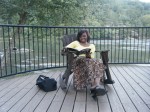
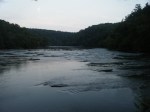
In search of a new writing group, I stumble upon unintentional access to the Chattahoochee River, an access that costs me nothing. Ordinarily, access to a body of water carries a stiff price.

In the backdrop of the establishment, I spy a body of water and realize that I am so blessed to live in a major metropolitan area that tucks the Chattahoochee into its waist, circular and all. As it goes about its business, I see people latching on for numerous reasons.

Fortunately, this end of the river boasts no crashing waves or unpredictable agitations to cause an unnecessary distraction. These sedate and subdued motions could have enervated my brain into introspection. Rather, I choose to allow it to energize my hand into literary scribbling of the most profound kind.

Sitting on the Chattahoochee

As I sit here on the bank, I realize that Atlanta can hold its own among cities calling themselves literary luminaries. I am truly blessed to live in a major metropolis boasting of an A-list of citadels of learning, a city that has been attracting intellects since Booker T. Washington, even if only to elevate the art of public speaking.

I am fortunate to live here where, when a shout for writing goes out, people take up pens (used loosely here) to answer with immediacy. I am discovering the depth of Atlanta’s literateness. I belong to several face-to-face literary groups, a good selection easily organized by like-minded individuals who could charge membership fees (like some of the online ones) but who do not. Their sole “ulterior” motive is to help each other grow in literation.

Sitting here today, I feel very well in my elements on this bank whose serene flow circles Atlanta’s waist and germinates creativity in me with gentleness. I realize that even though our patio doors do not open directly onto the Atlantic (although our distant neighbor, Savannah does), Atlanta has literary blessings in abundance: print media, online media, the film industry staking a firm claim, and printers and publishing outlets to give authors’ creations wings.

Atlanta not being a one-sector industry or a one-crop economy gives hope to writers and artists. It is not a mining town, a camera/photo city, a silicon-born city, one-university dominion, nor is it controlled by brewery, quarry, seafood, farming, or seaport. We certainly have access to all these varieties.

Even the railroad that gave it birth does not claim domination any more. Atlanta is truly blessed, and because I am like Atlanta in many ways, so am I. 

Exploring Genrelific® Situations

Words come to me out of the blue as inventions. For example, I used the word “fantabulous,” for the first time to my students in 1997 without realizing that someone else had documented its use in 1957. I invent words continuously and use them personally–blended words, unique words, and so on, but I never venture to clamor for the general public to herald their birth until now.

This morning, as I brewed my herbal tea and pondered over the topic for today’s blog, I sought to take stock of my versatility in the literary realm. I am a writer of many genres, meaning that I am prolific in those genres. In search of the ONE word that would capture my uniqueness and brand me at the same time, I (Frances Ohanenye) invented “genrelific” on February 7, 2012.

I went to the Lexico Publishing Company and to Merriam-Webster to find out how I can add my newly coined word into their respective dictionaries. In summation, usage is the passport for inclusion into that privileged class. Therefore, I encourage everyone to begin to use the word “genrelific.” The more people who use it, the higher the chance of my word being included in any dictionary. I searched the internet, and it does not exist.

For example, you could say, “My friend, Frances Ohanenye, is very genrelific. She writes across many genres.” Or, “My brother is a genrelific reader and does not restrict himself to one genre.”

I admit that my motive may seem self-serving for now, but ultimately, my goal is for the general reading public to describe writers who cross the boundaries of the literary world with one word instead of with a string of wordy morsels. “Genrelific” captures the literati, that group of authors, writers, and other people involved with literature and the arts.

I am realistic and patient. The process of inclusion takes weeks, months, and even years. I understand. I am not myopic at all either. I see the far-reaching use of the word, genrelific. We speak of types of art, movies/cinematography, music, and wherever categories and sub-categories exist within an industry. The applicability of the word is limitless.

To establish ownership of my coined word for evidentiary purpose, I took the liberty of corresponding with those two companies to queue myself on their waiting list and introduce my brainchild as well. Now, let us get back to my “genrelific” self. I am prolific in these genres: children’s, young adult (YA), mystery, science fiction, short story, poetry, religious/inspirational, and adult/realistic/women’s. I want to delve into creating plays/drama, mythology, romance, fairytale, historical fiction, folktale–which my father used to tell us a lot of, and others.

Kathleen Hall Jamieson‘s “Antecedent Genre as Rhetorical Constraint” declares that rhetorical situation determines discourse as well as antecedent genres. I admire Jamieson’s succinctness because past definitions of genres still control our present analysis, appreciation, and emulation. “Antecedent genres are genres of the past used as a basis to shape and form current rhetorical responses.”

I have penned at least one volume in each of the nine genres listed above, and some genres can boast of at least eight creations in my literary repertoire. I have many ideas marinating for many more explorations within each of the types of literature in which I have traveled.

That I have not dabbled into the romance genre purely as a writer is not for lack of desire; no pun intended. The muse has not called me yet. To be a writer, one must first be a reader. I devoured at least 100 of Barbara Cartland’s romance novels and by other authors, enough to inspire me despite myself.

I consumed at least 70 of René Brabazon Lodge Alan Raymond’s, (famously and lovingly known as James Hadley Chase) crime fiction novels, not to mention many from Agatha Christie, Sherlock Holmes, Ian Fleming (the creator of James Bond), and several more.

I read and memorized texts of classic novels (Charles Dickens, Jonathan Swift, Robert Louis Stevenson, Jane Austen, Horatio Alger, Charlotte Bronte, Guy de Maupassant, Nathaniel Hawthorne, David Henry Thoreau) and William Shakespeare’s dramas, the springboard for my rapture with literature.

I nourished my soul with Chinua Achebe, Wole Soyinka, Hilaire Belloc, Kofi Awoonor, and other poignant authors and poets. As a matter of fact, one year, I read at least 180 novels, not teacher-mandated readings, required texts, or textbooks, simply self-chosen glorious novels.

Now I write furiously. I write many genres and can write all genres. However, my creation relies on inspiration cascading like confetti rather than by a self-inflicted time-table. Who knows, when the inspiration floods my brain for romance novels, I will create that genre as a full bloom or any other genre my mind chooses to birth.

The type of literature into which I will never seek membership is horror. The simple reason is that I do not wish to stain or sell my soul because I may not be able to buy it back or get it back from the dark forces that inhabit that sphere. Superstitious? May be, but I have read both Steven King and Edgar Allan Poe, and they both scared the living daylights out of me and my house.

Venturing into many genres allows me to dabble into unrestricted spheres. I perceive myself as a living testimony of Richard Coe’s words when he said that “tyranny of genre” constrains individual creativity (Coe 188). Therefore, I allow myself to mingle within genres, cross their boundaries, shake hands with their inhabitants, and dine luxuriously among them.

In my mystery novels, romance abounds. In one YA novel, religion trumpets out of the mouths of youths like the Sermon on the Mount, and religious-infused allusions thrive. In my science fiction short story, realism and fiction fight for supremacy, but because I want it classified as a science fiction endeavor, that genre triumphs. As Amy Devitt states, “A genre is named because of its formal markers” (Devitt 10), and I wanted that story formally marked as a science fiction.

If I have failed to make it known before, unique words feed my brain like food and my brain feeds me unique words. Today will go down in famousness as the birthday of the word, “genrelific,” another synergy for the literary world.

©2012Genrelific by FrancesOhanenye