Realistic Fiction and Political Debate

What is the relationship between literature and politics? What should that relationship be? James T. Farrell asked these poignant and reverberative questions in his essay, “Literature and Ideology” (Farrell 1). I ask the same questions but channel mine specifically toward the genre of realistic fiction as I examine politics in the context of that literary genre. Realistic fiction paints a picture of events and characters as close to reality as possible. According to Farrell, writers have used literature as a weapon in class struggle (2). I agree with Farrell that fiction (as false as its name may imply) is an essential element in fighting for the narrator’s/author’s political views, even surreptitiously. I believe realistic fiction is the most effective tool in causing a revolution because of the depth of its platform, its deceptive nature, and its mass appeal. Before focusing on the three characteristics of realistic fiction, it is imperative to pause and offer a definition of literary genre, realistic fiction, and political debate.

Encyclopedia Britannica defines literary genre as “a distinctive type or category of literary composition (Das n.p.). Since no dictionary could offer a concise definition of the phrase, political debate, a condensed version of a definition would suffice. I believe that political debate is a discussion or an argument about political matters or a discussion of opposing political views. Since the focus in this section of our study is on realistic fiction, it is also imperative to offer a definition of that particular genre. From decades of teaching realistic fiction, I have gathered that it uses imaginary incidents and characters, and (sometimes) imaginary locations to portray similar and realistic events in our lives so that the reader could actually see himself or herself in the situation and recognize that such characters, such incidents, and such locations are relatable. Any topic under the sun and stars is a viable avenue for the realistic fiction writer to use as a medium to cause revolutions and change the world.

Literature (through realistic fiction) is “one of the arts which re-creates the consciousness and the conscience of a period. It tells us what has happened to man, what could have happened to him, and what man has imagined might happen to him” (Farrell 8). Because of the depth of its platform, the author of realistic fiction has no limit or page count. Passion has moved many writers to compose novels of hundreds of pages. Politics is a serious topic. In order to give political debate the honor it requires in realistic fiction, the author of realistic fiction needs to delve into the deepest realm of political issues and cause the world to turn on its axis.

Farrell states that authors can do so by “trying to smuggle ideology into literature” and thus seek to discuss and to enlighten people of serious matters in “an indirect and casual manner concerning the most serious problems which the human race faces” (6). These authors listed here were moved to unfurl their political ideologies; they sought to explore politics and wrote close to or over 300 pages: Ayn Ran’sAtlas Shrugged (1088 pages), Upton Sinclair’s The Jungle (475 pages), Robert Penn Warren’s All the King’s Men (464 pages), Larry Beinhart’s Wag the Dog (392 pages), The Master and Margarita by Mikhail Bulgakov (384 pages), The Handmaid’s Tale by Margaret Atwood (311), Aldous Huxle’s Brave New World(288 pages), and George Orwell’s 1984, 279 pages (Wasson 3). These works show an inexhaustive evidence of passion, politics, and political debate mired in dialogue or stark.

By its deceptive nature, realistic fiction can morph into any genre and can have any genre embedded in it. While it seeks to entertain, it delivers a political jab, upper cut, and knock out of the offending government or political institution. Realistic fiction is transcendent. It is a chameleon. It is assimilative. Farrell recognizes its nature when he states that realistic fiction limps, even crawls behind events. “This is especially so in periods of great social crisis and of historic convulsion” (7). We could not possibly insert a realistic fiction novel into poetry, but the reverse happens all the time. Many a time, the line is blurred between realistic fiction and the other genres that attempt to portray realistic life such as historical fiction, mystery, science fiction (somewhat), drama, and narrative nonfiction or memoir. The words written in realistic fiction have the power to generate ideas, inspire revolutions, and change the way we view ourselves and our place in history (8).

As for its mass appeal, realistic fiction has had a lasting impact on people and cultures around the world. Realistic writers examine conditions and describe injustice, misery, and spiritual and material poverty. “The realistic novelist deals with the conditions which exist as they exist. The attempt to tell the truth in a precise, concrete, and uncompromising manner is demoralizing” (Farrell 8). The internationally renowned writers listed here changed the world with their pens and with their stand on political issues, with their beliefs, and with the works they created from fictional accounts. More than a few have won the Nobel Prize to prove it. Authors of international repute include William Faulkner, Gabriel Garcia Marquez, Henrik Ibsen,  Harriet Beecher Stowe, and William Shakespeare (Bailey 24).

The realistic writer relies a great deal on his or her senses, imagination, intelligence, culture, and background to create a work of literature (Farrell 8). Realistic fiction solves political problems, even if it has to resort to allegory, symbolism, satire, parody, or any other form of bringing mankind’s folly or undesirable behavior to the fore in order to cause a change. Literature and its offshoot (realistic fiction) are a few of the most powerful means contrived by the human spirit to examine life and to cause ideological maneuvers and political revolutions. Without the restriction of space, the realistic fiction writer can explore any and all political issues in debates and outside of it.

Domestication Blunts the Edge of Revolution in Mary Barton 

In as much as many a workman or workwoman has a family, it is a known fact that revolutions are engineered by and are about workers, whether they are factory, domestic, scholarly, or industrial workers. Revolutions are not about the family. The critics who argued that Elizabeth Gaskell resolved the conflicts in Mary Barton by incorporating class violence into individual family scandal are incorrect. Gaskell did not resolve the conflicts for the families. As much as Gaskell sought to garner sympathy for the individual family, the drama was not and should not have been about the family; it was and should have been solely about the worker.

That Gaskell chose to domesticate the political revolution (while attempting to make it more personal) caused the edge of the novel to be blunt. The incidents that involved the worker were of sharpened and of focused interest to the reader. The worker, when not saddled by family, was happy:

[Excerpt 1] “She said in them she were very happy, and I believe she were. And Frank’s family heard he were in good work” (Gaskell 81).

Granted, revolutions can be personal, as in the personal interest of the worker, but it is more than that. It is much broader and much more political in nature and is not an arena for the family. Revolution is about the condition of the working person, not of the family. In the excepts below, each mention of the word, “family,” showed evidence of deliberate attempts by Gaskell to earn sympathy from the reader, but more so, it showed evidence of the family’s mismanagement of resources, of the family’s failure to practice population control/family planning, and of Gaskell’s attempt to cast the “master” in a bad light.

Evidence of lack of family planning/population control:

[Excerpt 2] “…In order that their only bed and bedding might be reserved for the use of their large family” (66)…

As Gaskell indicated, couples and lovers did not have any problems maintaining the wages they were paid or any problem having spontaneous fun:

[Excerpt 3] “Here and there came a sober quiet couple, either whispering lovers, or husband and wife, as the case might be; and if the latter, they were seldom unencumbered by an infant, carried for the most part by the father, while occasionally even three or four little toddlers had been carried or dragged thus far, in order that the whole family might enjoy the delicious May afternoon together” (5).

The men of business, the workers (when unencumbered by the family) seemed happy and knew how to portion his/her time and other resources for business and for pleasure: business came first so that the family can be taken care of:

[Excerpt 4] “There were happy family evenings, now that the men of business had time for domestic enjoyments” (45).

Jem Wilson rose in rank because he did not have a family to gulp his time and suffer his talent; he focused on his job and was able to invent a machine. After he was paid handsomely, the payment allowed him to save money for a rainy day. Even after his trial and acquittal for the murder of Harry Carson, and even after his co-workers refused to allow him to return to his job, Jem was able to find another job and did not have to worry about children at home needing to be fed, clothed, and catered to. In line with being unburdened, relocating to Canada or to elsewhere to find employment was not a problem for Jem; he did not have a family to strangle his ambition.

[Excerpt 5] “We have been written to by government, as I think I told you before, to recommend an intelligent man, well acquainted with mechanics, as instrument-maker to the Agricultural College they are establishing at Toronto, in Canada. It is a comfortable appointment,–house,–land,–and a good per-centage on the instruments made. I will show you the particulars if I can lay my hand on the letter, which I believe I must have left at home” (303).

Without hesitation or without the need to consult a wife, Jem responded immediately:

[Excerpt 6] “Thank you, sir. No need for seeing the letter to say I’ll accept it. I must leave Manchester; and I’d as lief quit England at once when I’m about it” (303).

Even the government, as Jem’s future employer, did not care about a family. The government’s concern was the worker, Jem:

[Excerpt 7] “They’ll never ask if the family goes upwards or downwards” (303).

[Excerpt 8] “Jem felt that it was a relief to have this point settled; and that he need no longer weigh reasons for and against his emigration” (303).

The Manchester labor union sent representative workmen to discuss terms with the Masters. During the negotiation, never was the family mentioned nor was there ever a negotiation between the Masters and the members of the representatives’ families:

[Excerpt 9] “So class distrusted class, and their want of mutual confidence wrought sorrow to both. The masters would not be bullied, and compelled to reveal why they felt it wisest and best to offer only such low wages; they would not be made to tell that they were even sacrificing capital to obtain a decisive victory over the continental manufacturers. And the workmen sat silent and stern with folded hands, refusing to work for such pay. There was a strike in Manchester” (135).

And there it was: A strike in Manchester! A strike between Masters and workmen.

(Sorry families, mine and others. I was assigned to argue against the family in this debate on revolution.)

Hyperlink/Multi-media Mini-me Project

This is a mini project I created to see what all has changed since I used Prezi last in 2011.

https://prezi.com/vcvqowe0ya1v/copy-of-all-about-me-frances-ohanenye/

Enjoy the music, “Kalimba,” by Mr. Scruff from the album Ninja Tuna. If it moves you, jam to it.

Frances Ohanenye On the Inprint Writers Workshop Website

It has been a very busy* month and year, and we are not even half way through the year.

http://inprinthouston.org/for-writers/writers-workshops/ Inprint_Writers_Workshop_FrancesOhanenye.jpg

I am on the “cover” of the Inprint Houston Writers’ Workshop website, the much coveted Inprint Writers’ Workshop.

How fast do the workshops fill up? The site opens at 12 (noon) sharp and offers several workshops.

Within 10 – 15 minutes, all the workshops are full, and each full-scale, eighth-week, workshop costs a little under $300. Aspiring writers, K-12 teachers, other college graduates, post-graduate students seeking admission into demanding post-graduate programs, college professors, and all others vie for a spot in these most challenging but rewarding programs.

Let me say, I was very fortunate to secure a seat. Like Robert Frost said, “And that has made all the difference” (Frost 9).

*Frances Ohanenye is also featured at these links:

*https://literarynomad11.wordpress.com/2015/05/19/i-am-on-the-university-of-houston-website/

*https://literarynomad11.wordpress.com/2015/05/20/frances-ohanenye-attends-the-reception-for-winning-imagination-grant/

https://www.facebook.com/KatyISDEducationFoundation

Work cited:

Frost, Robert. “The Road Not Taken.” Mountain Interval. New York: Holt and Company, 1920. Print.

Frances Ohanenye Attends the Reception for Winning Imagination Grant

CAM01677

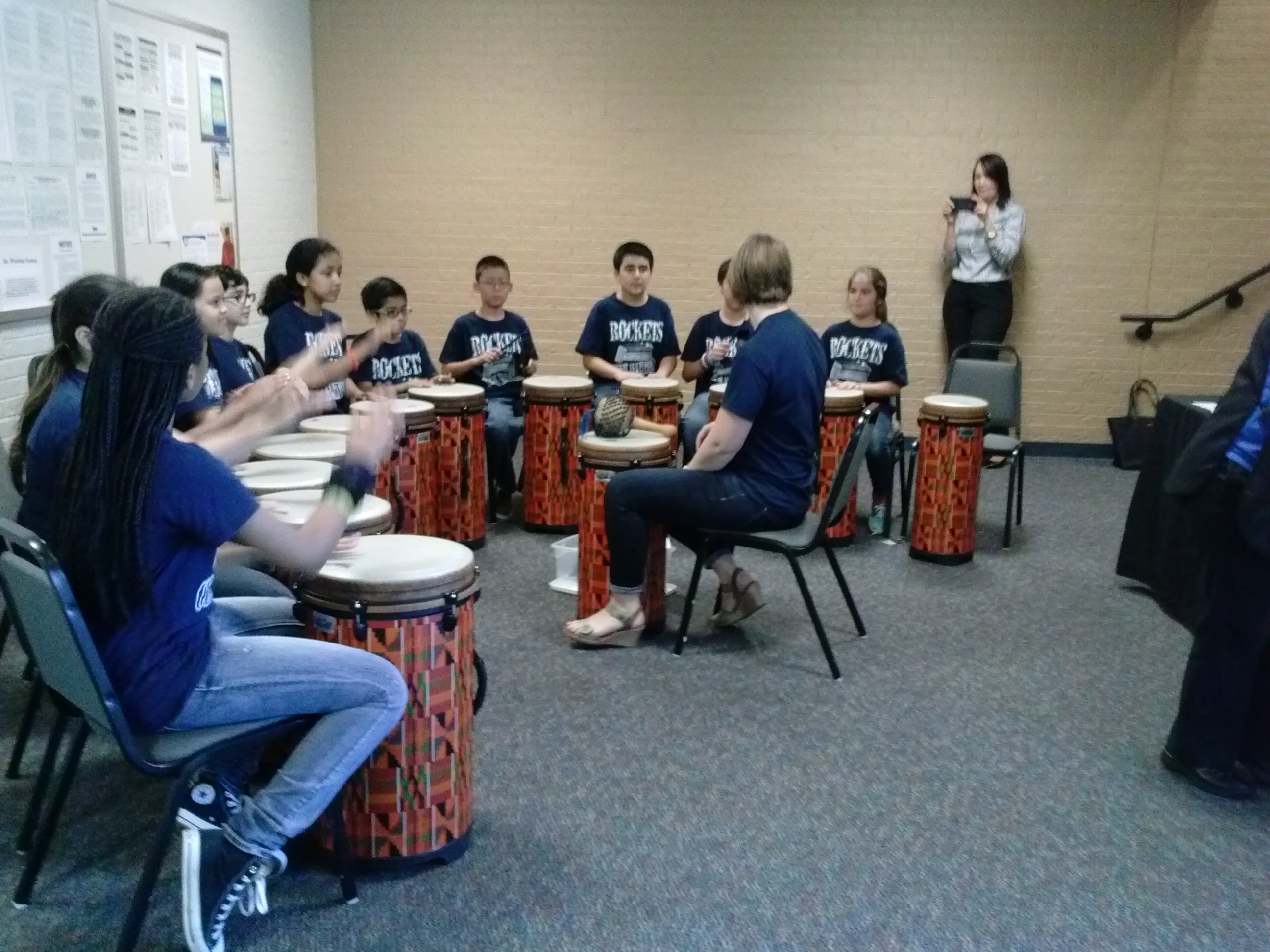
The drummers welcomed grant winners into the Education Support Complex (ESC) building.

May 18, 2015, was quite memorable. I won a Katy ISD Imagination Grant titled “Fearless Readers of Life-changing Novels” and was honored last night with the other grant winners.

CAM01678

Light refreshment/hors d’ourvre.

Grant_Reception_CAM01695

Frances arrives at the Grant reception.

CAM01694

Grant winning teachers recognized one by one.

CAM01687

During the event last night, I was honored to meet the board members and be among several students and teachers who were recognized for amazing feats and outstanding academic achievements.

CAM01685

The superintendent of Katy ISD, Mr. Alton Frailey, strides toward his seat in the board room during the Imagination Grant Award recognition.

The Teacher Group Photo 05-19-15

The teachers who won the Katy ISD 2015 Imagination Grant. Frances Ohanenye is in a pink shirt, third row from the front and on the right side.

The day I found out I won the grant! The committee surprised me in the Computer Lab where I was working with students. Apparently, they had gone to my classroom, and finding the notice I left on my door that we are in the lab, they came to the lab with the principal and surprised me. Needless to say, I was pleasantly shocked.

Congratulations to Today’s Grant Recipients
 Friday, May 8, 2015
Frances_Ohanenye_Wins_KatyISD_Imagination_Grant

Mayde Creek High School English teacher, Frances Ohanenye (center), wins “Fearless Readers of Life-Changing Novels” Grant. Pictured with MCHS Principal, Dr. C. Steele (left) and Katy ISD Imagination Grant representative (right)

Kudos from MCHS and Katy ISD:

Laura F.: Congratulations!!!! 

P. Davis: Hip hip hooray!!!!! congratulations…great job!!!

Lydia D.: Please congratulate Ms. Ohanenye for receiving the “Fearless Readers” grant for her College Prep class!!!!  Way to go, Ms. Ohanenye.

Kathie F.: Congratulations!!

Janet T.: Congratulations!

Amanda P.: Congratulations on both fronts!!! You have had an exciting week.J

Nicole M.: Well, that’s just awesome! Congratulations, Frances! I’m so happy for you. Things are definitely going your way!

Frances Ohanenye Is on the University of Houston Website

2014commongroundbanner3_UH

Screenshot of UH Honors Summer Seminars

I participated in the Honors College’s 2014 Summer Seminars at the University of Houston. Pictured above is my gifted group. We read several money-themed literary works and performed a menagerie of poignant pieces to the attendees:

  • Shakespeare, The Merchant of Venice
  • Willa Cather, My Mortal Enemy
  • Arthur Miller, All My Sons
  • Chinua Achebe, No Longer at Ease
  • Henrik Ibsen, Hedda Gabler
  • Leo Tolstoy, “The Death of Ivan Ilych

UH Link:

http://www.uh.edu/honors/Programs-Minors/honors-and-the-schools/common-ground/summer-seminars/

2015_Summer_Seminars_UH_FrancesOhanenye

From Theory to Literature: Marxism and The Turn of the Screw

Henry James wrote the quintessential novel and buried it in the most dizzying quagmire. His method, however, was admired by many turn-of-the-century authors including Joseph Conrad. James drizzled intricate structure, sustained irony, and the sophisticated manipulation of point of view all over The Turn of the Screw. Unlike Conrad’s novels whose settings journeyed all over the world, James remained locked on the British social and economic scene and layered the social-economic structure from the wealthiest (the owner of the mansion) to the poorest (servants). This short paper intends to apply Marxist Literary Criticism to Henry James’ Turn of the Screw as it explores important concepts in that theory: “from theory to literature.”

One of the notable Marxists, Friedrich Engels, would probably applaud James for attempting to hide his own opinions for the betterment of art. As cultured and as highly educated as James was, he attempted to bring about other realities: culturally, economically, socially, and gender wise, far removed from his own circumstances. On the contrary, Marxism would decry such an attempt. “Marxist literary criticism maintains that a writer’s social class, and its prevailing ‘ideology’ (outlook, values, tacit assumptions, half-realised allegiances, etc.) have a major bearing on what is written by a member of that class.”

According to Peter Barry’s interpretation, instead of Marxists seeing authors as primarily autonomous “inspired“ individuals whose “genius“ and creative imagination enable them to bring forth original and timeless works of art, the Marxist sees authors as constantly formed by their social contexts in ways which they themselves would usually not admit.

Applying The Turn of the Screw to Marxist criticism (or vice versa), it is imperative to acknowledge the significance of social and economic factors. As indicated earlier, the story is populated by the lower class: Mrs. Grose and an assortment of hired help, living or dead. Despite her attempt to see herself differently as above all the others in the house, and by virtue of her not being a relation, a guest, a mistress, nor a servant, the governess is still in the lower class because she received financial benefits.

Marxist theory sees progress coming about through the struggle for power between different social classes. There was a stream of conflicts in the novel: between the governess and Miles, between the governess and Flora, between the governess and Mrs. Grose, and between the governess and the ghosts. Additionally (and according to Marxism), one social class always exploits the other. Miles’ uncle has economic, social, and political advantage over the governess and all the people working for him, even if the power is from afar. The machination he put in place and set in motion churns in his absence to ensure that all parties contribute to the success of his home management and his peace of mind.

The result of this exploitation, according to Marxism, is the “alienation” of the worker (the governess) who performs “tasks whose nature and purpose ‘she’ has no overall grasp.” The governess finally confesses to not wanting to prolong “the fiction that I had anything more to teach him.” She had no overall grasp anymore as Miles’ teacher, caregiver, and protector. She knew she no longer possessed the skill necessary to teach Miles. She has been, according to Marxism, “deskilled.”

To Mrs. Grose (who is below her class by education, station, and by birth), the governess wallows in conflict by becoming sarcastic, insulting, and uses tacit invectives. Class dynamics and conflicts are very prevalent and critical in Henry James’ The Turn of the Screw. Sometimes the references are implicit. Other times they are immersed in dialogue. Even though the governess is of Victorian gentility, being heavily exploited and thrust into extremely demanding expectations and roles cause her alienation and ultimate breakdown.

Although Karl Marx and Engels themselves did not put forward any comprehensive theory of literature, other Marxists did. Marx and Engels’ views, Barry notes, seem relaxed and undogmatic: “Good art always has a degree of freedom from prevailing economic circumstances…” Henry certainly created a piece of good art in The Turn of the Screw.

Works Cited

Barry, Peter. “A Critical History of The Turn of the Screw.” (Ed.) Boston: Bedford, 1995. Print.

Nestvold, Ruth. “Literature at the Turn of the Century (1890 – 1918).”       http://www.ruthnestvold.com/about.htm. Web.

Wahrman, Dror. Imagining the Middle Class: The Political Representation of Class in Britain,       1780-1840. Cambridge: Cambridge UP, 1995. Print.

Whelan, Lara Baker. Class, Culture, and Suburban Anxieties in the Victorian Era. New York:       Routledge, 2010. Print.

One of the notable Marxists, Friedrich Engels, would probably applaud James for attempting to hide his own opinions for the betterment of art. As cultured and as highly educated as James was, he attempted to bring about other realities: culturally, economically, socially, and gender wise, far removed from his own circumstances. On the contrary, Marxism would decry such an attempt. “Marxist literary criticism maintains that a writer’s social class, and its prevailing ‘ideology’ (outlook, values, tacit assumptions, half-realised allegiances, etc.) have a major bearing on what is written by a member of that class.”

According to Peter Barry’s interpretation, instead of Marxists seeing authors as primarily autonomous “inspired“ individuals whose “genius“ and creative imagination enables them to bring forth original and timeless works of art, the Marxist sees authors as constantly formed by their social contexts in ways which they themselves would usually not admit.

Applying The Turn of the Screw to Marxist criticism (or vice versa), it is imperative to acknowledge the significance of social and economic factors. As indicated earlier, the story is populated by the lower class: Mrs. Grose and an assortment of hired help, living or dead. Despite her attempt to see herself differently as above all the others in the house, and by virtue of her not being a relation, a guest, a mistress, nor a servant, the governess is still in the lower class because she received financial benefits.

Marxist theory sees progress coming about through the struggle for power between different social classes. There was a stream of conflicts in the novel: between the governess and Miles, between the governess and Flora, between the governess and Mrs. Grose, and between the governess and the ghosts. Additionally (and according to Marxism), one social class always exploits the other. Miles’ uncle has economic, social, and political advantage over the governess and all the people working for him, even if the power is from afar. The machination he put in place and set in motion churns in his absence to ensure that all parties contribute to the success of his home management and his peace of mind.

The result of this exploitation, according to Marxism, is the “alienation” of the worker (the governess) who performs “tasks whose nature and purpose ‘she’ has no overall grasp.” The governess finally confesses to not wanting to prolong “the fiction that I had anything more to teach him.” She had no overall grasp anymore as Miles’ teacher, caregiver, and protector. She knew she no longer possessed the skill necessary to teach Miles. She has been, according to Marxism, “deskilled.”

To Mrs. Grose (who is below her class by education, station, and by birth), the governess enjoys the conflict tremendously by becoming sarcastic, insulting, and by using tacit invectives. Class dynamics and conflicts are very prevalent and critical in Henry James’ The Turn of the Screw. Sometimes the references are implicit. Other times they are immersed in dialogue. Even though the governess is of Victorian gentility, she is heavily exploited and is thrust into extremely demanding expectations and roles which cause her alienation and her ultimate breakdown.

Although Karl Marx and Engels themselves did not put forward any comprehensive theory of literature, other Marxists did. Marx and Engels’ views, Barry notes, seem relaxed and undogmatic: “Good art always has a degree of freedom from prevailing economic circumstances…” Henry certainly created a piece of good art in The Turn of the Screw.

Works Cited

Barry, Peter. “A Critical History of The Turn of the Screw.” (Ed.) Boston: Bedford, 1995. Print.

Nestvold, Ruth. “Literature at the Turn of the Century (1890 – 1918).” http://www.ruthnestvold.com/about.htm. Web.

Wahrman, Dror. Imagining the Middle Class: The Political Representation of Class in Britain, 1780-1840. Cambridge: Cambridge UP, 1995. Print.

Whelan, Lara Baker. Class, Culture, and Suburban Anxieties in the Victorian Era. New York: Routledge, 2010. Print.

From Theory to Literature: Applying Narratology to The Turn of The Screw

Narratology holds an enticement for me because I am not only a creator of literature, but I also am a curator of literature. I suppose my selection of the literary theory of Narratology to analyze Henry James’ The Turn of the Screw would be foreshadowed. My recent journey into Narrative Discourse wetted my appetite. In this discussion, I will explore how the theory illuminates relationships among “the narrated story text, the significance of narrated text, and the narrating act” and also demonstrate if and how Narratology exemplifies itself in the narrators in James’ novel into borderline, mixed, and ambiguous.

The theory that most suitably applies to Henry James’ The turn of the Screw is Gérard Genette’s Narrative Discourse. After reading the theory of, and after discovering the gaps in my own approach to literature (being ensconced in the formal modes of the story level), I became aware of what Genette meant, more aware of my superficial/traditional handling of literature.

This new theory opened up a window into these old three: the narrated story/event (intradiegetic), the signifying narrative text, and the narrating act (extradiegetic). Actually, as a result of the exposure to Narrative Discourse, I became annoyed with Henry James in The Turn of The Screw for giving his narrators the penchant for forcing suspense. I also was irritated at Douglas for holding his listeners/audience captive and using upper handedness in being extremely present in the narrated world (homodiegetic).

As a reader straddling the two worlds of reading the novel and applying it to theory, I recognize and appreciate James’ ingenious narrating tactic which took me aback. He kept the reader confused yet interested enough to try to muddle through the circuitous narrated story text and its 19th century brand of English. Additionally, as it pertains to the narrating act itself, Douglas’ proclivity for inserting himself dominantly in the narrated story (a story inside another story—Woody Allen’s forte) forced me to acknowledge Genette’s immeasurable gift to literature/Narratology. Genette drew a fine distinction between “who sees?” (focalization) and “who speaks?” He “re-conceptualized the relationships between speaker and the focalizer” and introduced “the necessity of accounting for focalization at the micro- and macro- level(s)”.

Genette acknowledged that the narrator should have a degree of narrator presence in the story, but even he could not have envisioned that authors like Henry James would give characters like Douglas the most liberal latitude in the narration. Apparently, James intentionally made Douglas to be seen and to be heard with theatricals of kicking the fire log, pausing mid-air in speech, fixing his listeners with a look of discontent, verbally putting down his listeners, and dominating the narration that was not about him, but he made it so as a right someone owed him.

Douglas features prominently in “the narrated story text, the signifying narrated text, and the narrating act.” That James kills off Douglas caused an indecipherable feeling in me. I was impatient to read the story without Douglas’ further theatricals and wished the unnamed narrator would take it up, but Douglas’ death shocked me, and even at that, it seemed unjust for James to give it a one-sentence allusion.

For the second topic of this essay, I examined Genette’s three distinctive classifications of characters into degrees of presence: borderline, mixed, and ambiguous narrators. I am not shirking my duty as a student of literature by refusing to classify Douglas into one of the three established categories. Douglas does not fall willingly into any of the three narrator categories. He fakes ambiguity but is not particularly borderline or a mixture of two or all narrator types.

Never in all the novels I read do I recall an author casting most or all of the characters into questionable and disparaging personalities. Douglas would be classified as homodiegetic since his narration is more limited. He does not appear to read minds. The opposite of that is the governess whom I would classify as heterodiegetic because she claims that she knows instead of allowing the reader to come to that conclusion. When the governess narrates her own story, as questionable as her personality is, she easily pigeonholes herself and can be classified as an ambiguous narrator since she is everywhere. Her lunacy causes her to seem to have dual personality and makes her appear schizophrenic as she badgers Mrs. Grose or anyone else in her hyperactive state in trying to solve situations that are clearly over her ability. She really is limited in her perception of anything and does not know the children are manipulative or when they choose to ignore her, which, in her state of delusion, she considers them “leaving her alone”.

In summation, Genette inaugurated many terms in his focused discourse about narration. His pervasive and influential treatise “set a new standard by providing” me with “comprehensive and well-articulated approach” to understanding his unique theoretical models. Genette forced me to reexamine literary relationships in deeper levels, a paradigm that every teacher of English should allow to shift him or her from traditional questioning of text to adopting innovative techniques when analyzing and when teaching text and other narrative devices.

When I applied Narrative Discourse to James’ The Turn of the Screw, Genette equipped me with the terminologies I needed and the invigorating confidence to examine the narrated story text, the signifying narrated text, the narrating act, and allowed me the self-assurance to plot narrators (Douglas and the governess) into these categories: borderline, mixed, and ambiguous. This journey of analyzing Genette has fulfilled my appetite of needing more knowledge of Narratology, especially Genette’s Narrative Discourse.

Works Cited

Barry, Peter. Beginning Theory: An Introduction to Literary and Cultural Theory. Manchester, United Kingdom: Manchester University Press, 2009. Print.

James, Henry. The Turn of the Screw. New York: The Project Guttenburg. 2008. eBook.

Knudsen, Stephen. “Beyond Postmodernism. Putting a Face on Metamodernism without the Easy Clichés.” Web. 27 September 2014. http://artpulsemagazine.com/.

Pier, John. “Gerard Genette’s Evolving Narrative Poetics,” Narrative, Volume 18, Number 1. January 2010, 8-18.

Unit 5: Expository Reading and Writing

We have discussed different types of expository essay in this unit.

Cause and Effects

*Compare and Contrast (Chapter 9) in the packet: Compare cars that use gasoline and electric cars and compare traits parents and their children have

*Problem-solution (today’s activity): Choose one of the two mentor texts on monks and babies in intensive care units.

*Classification (Chapter 8 in the packet)—Group information according to teacher-specified guidelines on a student-created organizer.

Description

You have explored classification and compare and contrast early this week. Today, you will begin the exploration of the problem-solution type of expository essay.

For these types of essays, you have been required to read critically. What is the meaning of critical reading?

Critical reading is an essential strategy to help a reader take apart dense readings and to deepen comprehension by doing the following:

  • Identifying explicit and implicit textual information, including main ideas, overall effect, and any possible “arguments” made by the text.
  • Identifying and evaluating devices the author/writer uses to create tone and support an argument, idea, attitude, or purpose.
  • Drawing and supporting complex inferences from the text to summarize, draw conclusions, and distinguish facts from simple assertions.
  • Identifying and analyzing how an author’s use of language appeals to the senses, creates imagery, and suggests mood.

Assignment:

1. Differentiation: Select one mentor text that appeals to you. Read it criticallyMonks Need to Recruit–Problem-Solution  or An Electronic Eye on Hospital Hand–Problem-Solution

2. Retrieve the problem-solution organizer and provide all required information:  ProbSolution_NYTLN_Assignment

3. Submission: Either print the finished product and submit it physically or electronically through e-mail: franceseohanenye@katyisd.org.

Due date: February 27, 2015 

Happy MLK Day! See “Selma” and See Your Past, Your Present, and Your Future

I have seen a good ten movies or more in the theaters in the last four weeks, and I had not anticipated any of them as much as Movie_Selma“Selma,” for obvious reasons. Elsewhere in this blog, I had mentioned that recently, I had taken to waiting for the credits to glide to the end because I never know whose name will surprise me in the line-up.

I knew Oprah was among the sleuth of famous producers and directors for “Selma.” Still, I was in for a heart-happy shock when I saw another famous name in the mix: BRAD PITT!

Yes, according to The Wrap, Angelina Jolie’s husband was already a producer of the movie under his Plan B company, and Oprah (under her equally famous Harpo) joined him. I actually thought it was the other way around.

It is noteworthy that prominent Nigerian- and foreign-born actors featured in the lead: David Oyelowo as our beloved (and my father’s name sake) Martin Luther King Jr., Carmen Ejogo as Coretta Scott-King, and Lorraine Toussaint as Amelia Boynton Robinson.

Another pleasant surprise was the last song in the movie, “Glory,” a collaboration between Common (who played James Bevel in the movie) and John Legend, a song already nominated for the Golden Globe, and a song that paid tribute to Rosa Park, Michael Brown of Ferguson, and MLK’s efforts and leadership in Selma.

I saw “Selma.” I gave me a chance to appreciate the sacrifices of our Civil Rights heroes mentioned and implied in the movies (MLK, Coretta Scott-King, Andrew Young, Hosea Williams, David Abernathy, John Lewis, Annie Lee Cooper, James Bevel, and a host of others who fought the fearful fight).

The movie gave me a chance to appreciate the present liberties we enjoy. Those sacrifices include life, safety, finance, and much more. It gave me a chance to look forward to my future, hope we make strides in safeguarding and preserving the lives of our black youth, and change the laws that condone the unforgivable acts of taking a black life.

Between 1999 and 2014, 76 or more unarmed black people have been killed while in police custody. I look forward to the future when the law will put an end to this atrocity.